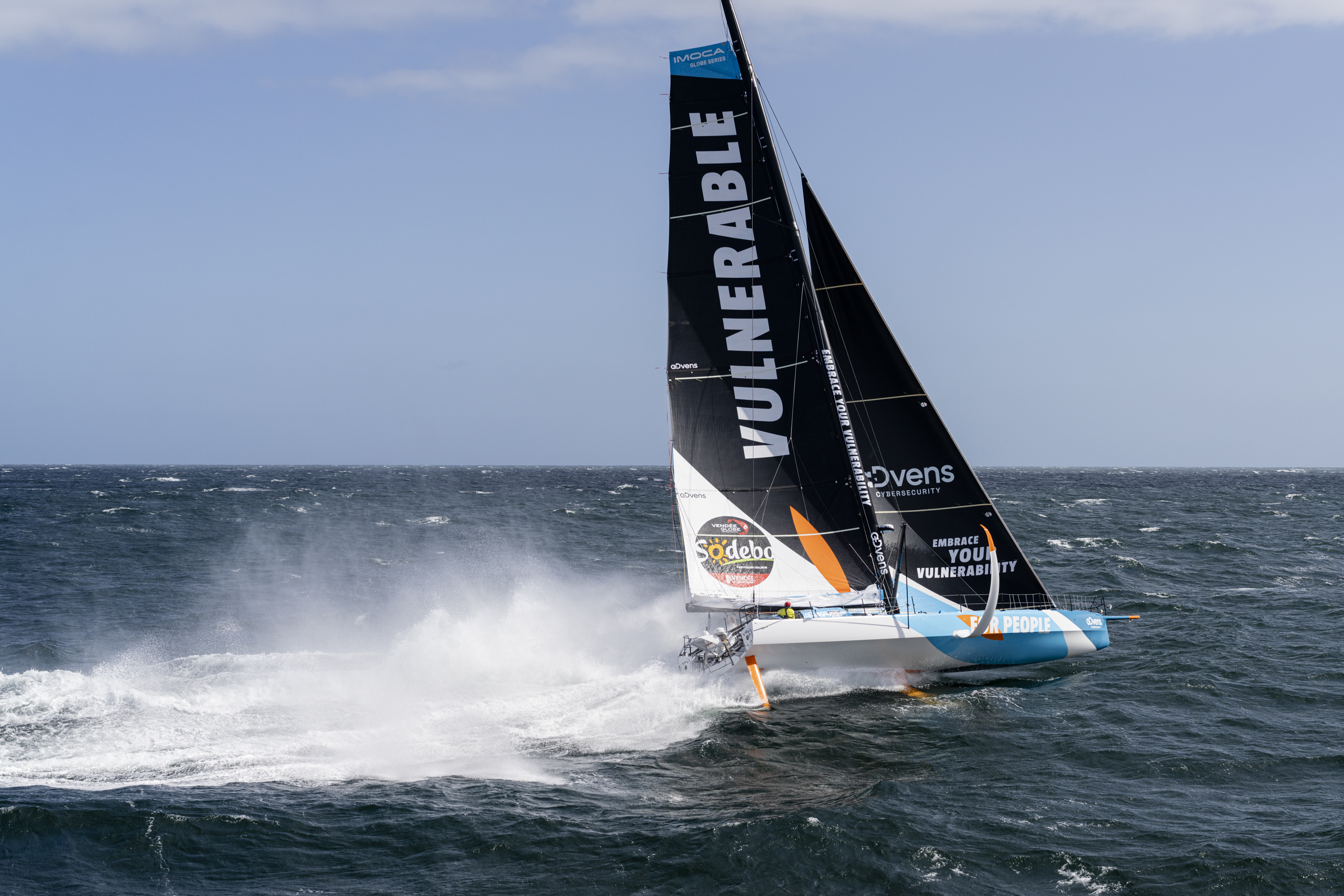
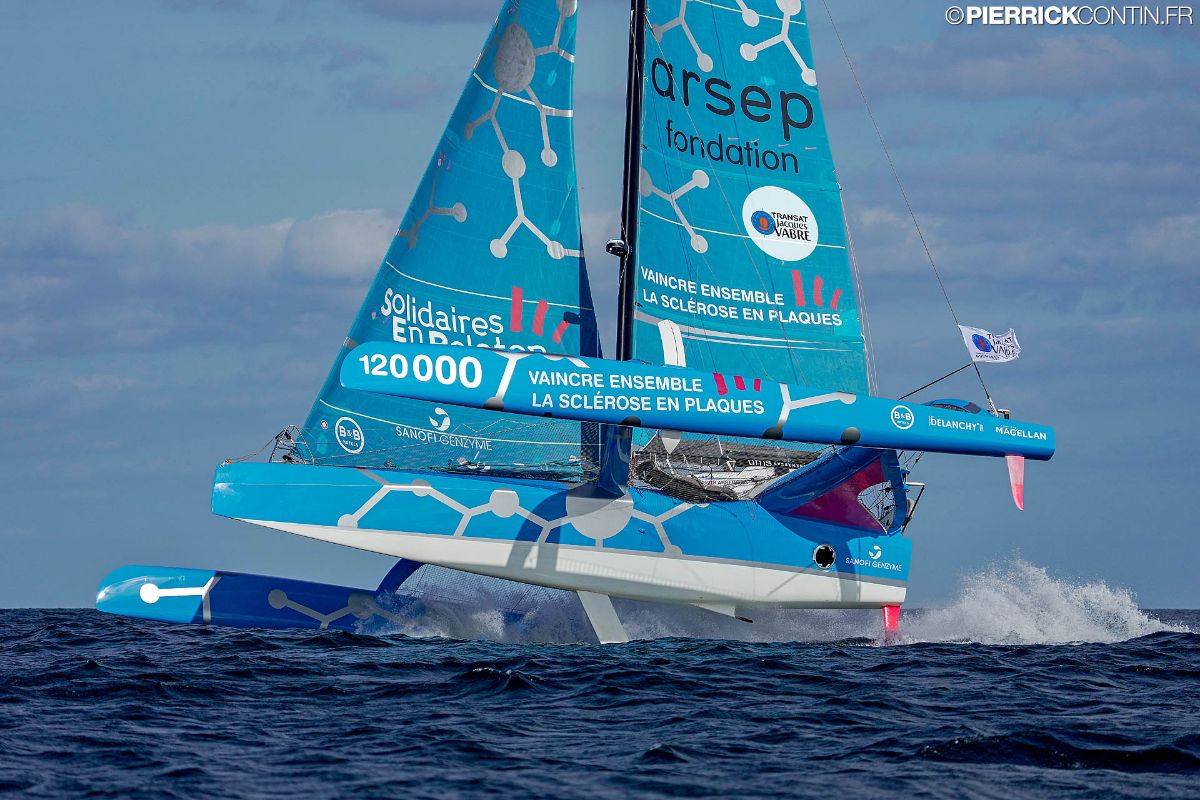
As I write these lines, if we except the Class40s, most of yachts competing for the legendary two-handed Transat La Route de L’Or have reached La Martinique.
If we concentrate on the 18 IMOCAs and on the 10 Ocean Fifties lined up for the race, in each of these two classes, 50% exactly are named under a philanthropic cause, it being a foundation or an association for instance.
Most OCDE countries encourage donations to causes of general interest through tax incentives. A given percentage of the investment in these ocean racing projects being offset their corporate tax. The principle pursued by the lawmaker with these facilities being to encourage money flows to domains of common good such as culture, education to list all but a few, domains that are not designed to respond to return on investment criteria stricto sensu.
Awareness and research to fight climate change is very often a good match, albeit not exclusively, between ocean racing teams and foundations for obvious reasons. Metaphorically, a racing yacht rounding the planet in 40 days which is the current record, without using a drop of fuel and within a time unattainable by conventional navigation means, speaks volume about the potential of natural sources of energy, the wind in this instance.
Beyond the power of metaphors, ocean racers were one of the first whistle blowers for plastic pollution when sailing past bottles and other containers in the roaring fifties, hours of plane from the closest land, and many Vendée Globe competitors have been tasked for more than 16 years now, to throw measurement instruments in their wake, in areas of the planet hardly ever visited by other vessels. This type of collaboration between Vendée Globe teams and the world of science is very well spread in the fleet allowing a whole range of useful data in a very cost effective way.
Lastly, when it comes to the natural synergy between the ocean racing community and environment concerns, racing prototypes are sometimes test labs for developing more virtuous processes applicable in the wider industry of composite materials. For instance; in collaboration with French industrialist ARKEMA, the top end prototypes of the Ocean Fifty fleet, shipping yard Neo Sailing Technology is using a process whereby the fibres and the resins can be separated at the end of the cycle, then reused. Right now this process is used for glass fibre which is mandatory for the hulls of the Ocean Fifty trimarans, showing by A+B=C that step change towards an almost decarbonised end-to-end process can be made with more compromised with performance objectives. This process seems applicable to carbon fibre…Doubtless the IMOCA class and the management of The Ocean Race will look into this and alternative for future IMOCA prototypes, especially if this switch makes no compromise with performance as it has proven to be the case with the Ocean Fifty trimarans.
It is all nice and good, but what are the trade-offs for a business in deciding to fund an ocean racing program under the banner of a foundation or an association, therefore accepting to give away their company name for what is regarded as one of the main asset of such program: its name precisely, quoted in rankings, in the media, etc?
If we look back at the boats racing under a philanthropic cause, most if not all of them are B2B businesses and it makes sense. For a B2C business, its brand(s) is/are just as good as shareholder value. I am not saying that this won’t happen, but when it will my guess is that it will be for dominant, global brands who could communicate about mineral water irrespective of its brand like Evian did a couple of decades ago, or because they invest in a portfolio of sports just to cover yet another segment. Mind you, Red Bull was a team co-sponsor on the 37th America Cup, but we are talking about inshore racing, with budgets 10 times more expensive than in IMOCA. Ocean Racing is a very different ethos….IMOCA are in many ways just a spectacular as the AC35, but the former has clout, magic and poetry that the Cup by DNA cannot buy can’t buy: they are not design to go out there, on the oceans where innovation and technology can meet aventure “out there” where nobody goes. They cross then oceans, linking countries and their culture. The latter by contrast (the AC35) would likely break in most english crossing…With quite a lot of luck and the possibility. of picking a perfect weather w they could break the existing record established by Mzaerati 70 foot trimaran skippered By Italian Giovany Soldinin in 2021 at a bit more than 35 knots. It would be interesting exercise but AC37s and soon the AC 38s are not designed for this, and odds that a team being at the right time and at the right place, with a perfect whether window is next do inexistent …I and this is thread of thoughts I would delighted I would like to discuss with Red Bull.
The structures and level of incentives vary a bit within OECD countries but follow the same principles. In France, 60% of the first 2 million euros invested in an ocean racing program under a philanthropic structure can be offset from the corporate tax return, then 40% for the rest of the program. In IMOCA for instance, for a three year-program starting with The Ocean Race 2027 and concluding with the Vendée Globe 2028, and if we take the assumption of a single sponsor absorbing 5 million euros per year for operations and activation, with a corporate tax currently at 25%, we are talking about a 10.5% savings for the sponsor and 1.6 million euros going to the philanthropic cause. For an Ocean Fifty team, centred around France and typically run on 1.5 million per annum basis, the savings to the sponsor would add up to 15% with 225K funding the supported cause. So much for mean spirited comments sneering that corporations are engaging into these programs through foundations for next to nothing. The gains are effectively very reasonable, and by this, I mean “just fine”. Law makers are by and large drafting balanced, fit-for-purpose legislations at least on this front.
There are deeper reasons for the uptake of philanthropy in ocean racing when the partner is a B2B business. These reasons go far beyond “logo slapping” which remains the key for visibility within its consumer base for a B2C business. The deeper reason deals with “Reason for Existence”, or what a company vision is, broadly speaking its societal and environmental role. Not all B2B business engage in ocean racing programs through a philanthropic cause for sure, but this is an elegant way for doing so.
If we take aside France and New Zealand where ocean racing is a national and mainstream sport—and the America Cup for the latter—there are sports like soccer or F1 which offer its partners much higher mainstream audience, but it is not necessary a problem in our sport. Giving away the naming of a racing prototype of a company in favour of foundation is not giving away everything. The funding partner still has the right to put its logo on the boat and activate the partnership for its own benefits across regions and business functions, connecting precisely with this notion of “reason for existence” which is tied to the longer-term vision of global corporation.
How does the future look like for philanthropy in ocean racing? The present is anything but. short of tensions for sure, whereas in geopolitics or with national budgets under pressure as discontent grows, and many global players, some more than others depending on their industry, consequently taking a cautious investment approach. As far as philanthropy is concerned, it is not unlikely that in some OECD countries the criteria for allowing tax incentive will come under greater scrutiny. Yet firstly, the range of issues embraced by the philanthropic space such as awareness for climate change and related research, education, or equal opportunities between male and female, all these issues remain just as urgent and secondly, the incentives for supporting these causes remain relatively marginal if we look at the afore mentioned numbers.
To conclude, and when it comes to answering the question raised in this article, I am conservatively optimistic when it comes to future prolific and mutually rewarding collaborations between the worlds of philanthropy and ocean racing, and this for a couple of reasons. Firstly, the “reason for existence” for global players has in the space of a few years become has become a non-avoidable topic with some legal implications is some regions like France, tied up to shareholder value, and secondly because of its intrinsic values, ocean racing projects more credibly than others sports directions stated in some forms in most of the CSR and ESG statements of most of these global players,
Alban James
Consultant, mediator and broker in ocean racing projects.